Unable to find time during the week to finish my review I instead started re-reading! Go “Everything is Illuminated!” I’ve read it twice and I still greatly prefer the movie but I felt like something not terribly serious so Jewish magical realism it is. In the meantime enjoy some videos from the movie. Maybe I’ll do a two in one review!
Fun fact: did you know that Alex in the movie is played by Eugene Hutz, the lead singer of Gogol Bordello?
I feel like switching up right now. I know I’ve been saying for a month that I want to do Maggie Anton’s book next but last night it dawned on me that last time I went to the library (yes actual physical building that happens to be conveniently two blocks away from my work), I grabbed only books that would be blog appropriate. So there are three (count them three!)books that seem exceptionally promising sitting on my desk right now gathering dust while instead I am reading about George III on my tablet. How am I over-committing myself already? Its only going to be my fifth review.
So…….I shall be choosing amongst the three very different books below (interesting how all the covers feature woman but only in Anton’s book do we actually see a face – must because in the ancient times women were less shy about their faces?). Maybe I’ll review the next one. Maybe I will read for pleasure of it alone.
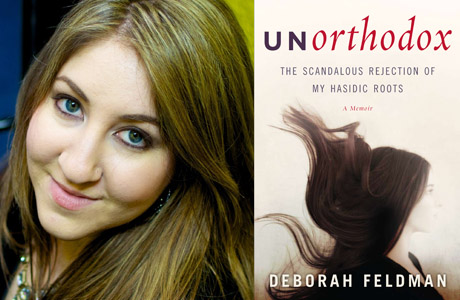
So it may be I will next find myself in Babylon with Hisdadukh or Istanbul with Hannah amongst the opulence of the Ottoman court. Or perhaps in NYC again with the sequel to Unorthodox.
I will start my review with a disclaimer. Below are my musings on this amazing book, not what I would call a review in any strict sense.
Why this book?
I first came across this story a few months ago. One of the Jewish groups I am a member of on Facebook, posted a link to a video that was described as showing a few moments in a Polish shtetl on the eve of World War II. I clicked on the link, watched the video and promptly almost burst out in tears at my desk. I’ve watched my share of documentaries on the atrocities of the Nazi genocide and both “Schindler’s List” and “The Pianist” made me cry so hard that I had given myself migraines. So I thought myself if not immune, then at least somewhat stronger in what I can handle. It’s an entirely different experience to watch the dead when they are visibly dead. It’s heartbreaking. It’s monstrous. But you CAN’T do a thing about it. It’s a whole other kind of hell to watch happy people crowding around a camera hoping to see what’s going on, hoping to get on film, or completely oblivious of the fact that a camera is recording their every moves knowing that within a number of years that one can count on a single hand most of them would be murdered. How do you reconcile the knowledge of the end with visions of mundane times? And then while indulging in my weekly search for a new book to read through my library, I stumbled on Glenn Kurtz’s ” Three Minutes in Poland,” the book spawn of the film. I will honestly admit that I was crying while still reading the intro. This was some feat as I began reading it while commuting to work on a local train and local train ride is not a place where one wants to admit vulnerability.
The story
So how does a film strip translate into a book? In 2009 Glenn Kurtz stumbles on a film of his grandparents’ long ago European vacation while going through stored items at his parents’ house in Florida. Amongst such popular European tourist “traps” as Paris and Switzerland, for merely a day in 1938 David and Lena (Liza) Kurtz visit a Polish town Nasielsk where David was born in the late 1880s and shoot three short minutes in a life of the largely Jewish shtetl a mere year before the Nazi occupation. Its three minutes of sweeping panoramic views of the town’s pride and joy, the synagogue, three minutes of children jumping into the screen, three minutes of people going about their day oblivious to the camera, never in the know what is just around the corner. Kurtz, however, is not oblivious to the significance of the film and gets in touch with the Holocaust Museum in DC to get the film restored and documented as part of the Steven Spielberg Video and Film archive. The entirety of the 14 minute film (both in color and black-and-white) including the 3 minutes in Poland are now available for view at the United States Holocaust Museum in Washington DC and can be viewed at this link. The David Kurtz Collection </a
The story could have ended there but in fact it was just the beginning. A granddaughter of a Nasielsk man viewed the video and recognized her grandfather in a thirteen year full faced boy angling for screen time in several separate moments of the film. She got in touch with the Holocaust Museum and eventually Kurtz himself. This discovery took him away from the novel he was trying to write and sent him in a multi-year and multi continent search (even into the bitch of a Polish irrigation ditch) to learn about Nasielsk, to tell as many stories of the Nasielskers still alive and to identify as many people in the film as possible and tell their stories. In the course of the search we meet Morry, Grace, Lesley and others, the few remaining Holocaust survivors of the 80 Jews from the 3,000 strong Jewish community. From some Kurtz learns about Orthodox childhood in a Jewish town. From others he learns gossip from the long ago. From most he learns about their survival in the sea of death. And to all of them Kurtz brings back painful memories while putting them once more face to photo with their neighbors, friends, and parents for the first time since 1939.
Lessons of “Three Minutes”
So. I loved this book. I didn’t want to stop reading it. I cried. I smiled. I cried again. And I was filled with love for my people and their strength. This book was a bright light from the time of shadows. It made me once again consider the miracle of my grandparents’ survival. Like some of the Nasielskers, my maternal grandparents were evacuated from their homes to other lands, in their case, Central Asia where they eventually met each other. And like some others, my paternal grandparents spent the war years in the ghetto but were saved by the miracle of geographic chance. They were lucky and here I am. The times for the Jews are once again trying. Anti-Semitism is not eradicated. There is still plenty of hate and violence. This is why it is important to remember these stories, and to give them life. Kurtz says “It’s going back and saying, Yes, there was a world.” This is the world that we must remember, honor and cherish. This is the world of Nasielsk, of Shargorod, of Warsaw, of Vilna, of Kiev. As a child of survivors and the heir of those that made it and those that did not, it is my responsibility to share their story. And in the trying times of today when a Jewish fraternity in my alma mater, UC Davis, gets defaced by swastikas, when a kosher supermarket in Paris gets attacked and people within are killed because of who they are, I must stand up and say along with Kurtz, “In a place where there is no person to make a difference, strive to be that person.”
In time for the Auschwitz Liberation Day, this is dedicated equally to victims and survivors.
Additional information
For those interested, here are a few more interesting relevant links.
1. A link from a talk Kurtz did for Ted.
This is what I have planned for the blog next. I read “Rashi’s Daughters” series a few years ago and really enjoyed it so when i found out about this series i knew i had to give it a shot. This is history of my people we are talking here, the time of the birth of Talmud. What fun to come! Who is excited? And maybe after, I re-read “Rashi’s Daughters” and jump forward in time?
I didn’t have to labor through Unorthodox but my mind rebelled greatly against dropping it practically every time some example of what I perceived as backwardness reared its head. And it happened A LOT. There are so many points in the memoir that were heartbreaking. So many times when I felt claustrophobic. Many times when I cringed and hugged myself. And so many times that I thanked my lucky stars to have been born where I was. And this is coming from someone born in Soviet Ukraine with its open policy of religious and ethnic repression.
Unorthodox is the memoir of Deborah Feldman’s life and subsequent breaking away from the Satmar Hasidic community in New York. A daughter of a mentally ill father (whose specific illness is never clear) and a mother who left the community, Feldman is raised by her deeply religious grandparents, both European Holocaust survivors. The Satmar community they live in Williamsburg is a deeply Hasidic community of followers of the charismatic Rebbe of Satmar ( a Hungarian city of Satu Mare). Feldman lives the life of a typical Satmar girl: learning to cook with her grandmother and fearing to disappoint her grandfather, going to school to learn what is expected of a good Jewish woman, and dreaming about getting married and becoming independent. But her life is not enough because Feldman never feels she be song’s whether because her parents are not really around or because she simply wants more. Even as she goes through the steps expected of her in agreeing to a match with a man she barely knows, Feldman doubts what her true path should be. Instead of rooting her in her community, the failure of her marriage breaks her further away until she eventually leaves her community behind.
Feldman invited a hell of a lot criticism with her book. After if I finished reading, I decided to take a gander online to find out a bit more about Feldman. There are websites out there literally devoted to denouncing her for the lies about the community. Her parents’ divorce documents are shown, her childhood photos are touted and he friends decry that she never indicated she was unhappy and that she had dramatized her life and blackened her religion and painted them as backward monsters, fundamentalists and criminals. Is it true? Feldman only knows, and I found her story compelling and too many things about it rang too true to be lies. But take a read and judge for yourself.
These are some of the things I learned about the Satmar from Feldman’s book :
They do not much care for the English language, spoken or written and they actually forbid the reading of all materials they perceive as secular
Satmar women shave their heads fully unlike their Orthodox sisters. Wearing human hair wigs is also frowned upon.
Satmar education offers bare minimum of US educational curriculum requirements. Meaning they do not even offer the equivalent of a high school diploma.
Matchmaking for the Satmar begins in their teens and an unmarried man or woman beyond the age of 20 is considered somewhat of an embarrassment. Also, until the oldest child is married, it is not considered proper for the younger siblings to marry.
On average, two weeks of every month Satmar women spend “unclean” and their men are forbidden from touching them. I don’t need to get graphic but let it suffice to be said, that they have to show proof of their cleanliness to a rabbi if they are not positive they are ready to be touched.
Satmar community has zero sex education. Women are discouraged from exploring their bodies. Men apparently turn to each other to get off and very often the newly wed do not have any idea how to consummate their marriage with the least worrisome side effect being prolonged non-consummation to the most worrisome need for an ER visit.
Abuse of all varieties is tolerated, from coping feels in the ritual mikvah (ritual cleansing bath) to child abuse.
Satmar follow their own laws, from having their own ambulances to their own police, and don’t seem to find the need to adhere to the law of the land.
Any Jew who is not a Satmar, is not considered a Jew. We are all gentiles if we are not Satmar, even if we simply stopped following their rules.
Most people have forgotten her name. Only those that have read the Bible, know her story, the little of it that the authors of the Torah deign to tell us about. Dinah, the sole daughter of Jacob-Israel, the father of the twelve tribes of Israel, aka Jews, merits a mention of her name twice in Vayishlach chapter of Genesis. She is mentioned only when she is born and when she becomes the cause for the slaughter of the males of Shechem. Dinah is abducted and defiled by the prince Shechem who then wants to marry her. Her father will only allow this after the prince and all the males of his city submit to circumcision. When they all do and are laying wounded in their homes, two of the sons of Jacob with their men descend upon the city and kill all the men and loot the city. They then take Dinah from the palace and leave the city. We have no idea what happens to Dinah after this happens. Her name is never mentioned again. So in the entire “story” of Dinah, she is not even an active player. She is essentially a name drop.
In “The Red Tent”, Dinah is a real person. From the first lines of the book, you get the full sense of her as a real human being, not as a character in someone’s book, but a real, living, breathing woman. Though the book starts similarly toned to the Bible, by telling a story of her family, Dinah tells us the story of the women in her family, the story that the readers of the Bible really don’t ever hear. She first tells us the stories of her mothers’ youths: both her birth mother Leah the Earth Mother, and her sister-wives, Rachel the Beautiful, Zilpah the Witch, and Bilhah the Kind. Men are incidental to the story of Dinah’s mothers and her own childhood. They are there, you know their names but they are not active participants. In the red tent, where all the women of her childhood go to congregate in sisterhood during their times of the month, Dinah grows up with the stories of goddesses populating her mothers’ worlds, the goddesses governing everything from childbirth to puberty. She grows up to know that being a woman means to be strong and skillful, that it means to be open to all possibilities and gifts of the world. As she learns about herself, she learns to love being a midwife and it is this love that brings her to her prince, Shalem when she assists Rachel with a birth that takes place in the palace. As they fall in love at first sight, they lose all sense of caution and the die is cast. When Dinah’s brothers take her out of the city covered in the blood of her beloved husband, she curses her brothers and her father and disappears from their history forever. Dinah ends up in Egypt and lives an entirely different chapter of her life eventually coming back full circle to the curse that she placed on her family.
It’s needless to say that I loved this book as desperately the second time I read it as a 32 year old woman. I may have seen Dinah the impulsive teenager in a less romantic light, but I also saw and appreciated Dinah the woman in Egypt. This story is not a fanciful imagination of a feminist author. The Red Tent is Dinah’s opportunity to speak in her own voice. She is confident, unencumbered by worries of inferiority and social class. She is a woman who is a strong woman because she is raised by such women. She sees visions like her brother Joseph and feels the presence of her gods, she makes her own choices, she heals and helps bring new life in the world. She loves with her entire being and shares herself completely. She is a full kaleidoscope of a human and you root with her even as you cringe with the steps she takes and smile when she is finally happy. She comes into her own in her own time, on her own terms, and when she is fully ready. In Dinah I find a complete woman, someone who I would love to have met in my own life.
In retrospect it may have been a bit wiser to choose a book slightly farther away from my heart. Note to the wise, reviewing a book written about one’s hometown by a non-local who may have had access to biased information about the said town and its inhibitants, is not a good one. I caught myself at least once outraged because the author mentioned something I patently knew to not be the truth. I ranted and raved about it to my long-suffering boyfriend. Who took it patiently like a lovely man he is and just gave me a bite of leftover pumpkin pie.
But anyway……..I AM DIGRESSING. “The Red Shtetl” is a history of a Ukrainian shtetl and its Jews, from its early days in the late 16th century to Y2K. The town grew from a tiny merchant outpost mostly settled by Jews who were invited to the Polish territories by the magnates themselves. Here the town and its community grew and mattered, much more than I anticipated. Shargorod survived many things in its four hundred plus years: multiple Ottoman invasions (fun fact-it was known as “little Istanbul” between 1670s and 1690s), several Cossack uprisings (most detrimental being the Chmelnitski pogroms of 1648), the switchover in ownership from Poland to Russian Empire, and the advent of the USSR. To my shock, I also found Shargorod to be in the midst of both the Shabbatai Tzvi/Frank heresies (they were both false messiahs from mid 1600s) AND the rise of Hasidism in the 1700s. Baal Shem Tov, the founding prophet of Hasidism himself, was reputed to have visited my humble little town. Jewish life in Shargorod managed to flourish through the Civil War of 1917-1920 despite the pogroms in which many including my great aunt were murdered. It survived in the homes of the Jews even after the Great Synagogue built in 1589 was closed. It survived because Shargorod’s Jewry was spared during the war. Instead of the Einsatzgruppen killing thousands mere miles away, Shargorod survived because it was under Romanian control and the community closed in on itself to survive with the assistance of the local Ukrainian populace with whom the Jews relatively harmoniously. It is only now that Shargorod is at the end of its life as a Jewish town, mostly because we have all left in some shape or another.
(The Great Synagogue)
I can’t say definitively that I loved the book. I found it immensely educating and written simply enough. It touched my heart to see the photos of the people I grew up knowing and to finally know some of their stories as an adult. I appreciated the care that the author took in finding as many authentic voices as possible. It taught me the history that I needed to know and made me understand where exactly my family came from. I couldn’t quite get passed my annoyance though. I guess some recent history felt too much like gossip that I knew to not be the whole truth. Overall, I would still recommend it because in the end Shargorod truly came alive in my mind as both my hometown and a typical shtetl for those seeking authenticity.






 Jewish Books Are Awesome